
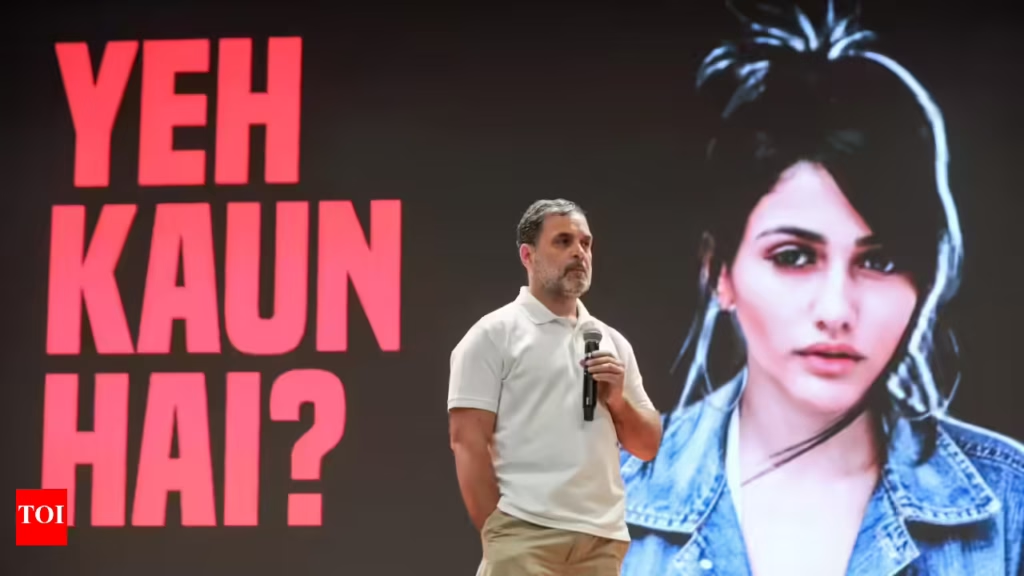
When Rahul Gandhi, the leader of the opposition in India’s Lok Sabha, presented what he called the “H-Files,” alleging large-scale voter fraud in Haryana, he started a series of surprising claims. One of the most unusual? That the same photograph of a Brazilian woman was used multiple times in the Haryana electoral register under different names.
The claim and the photo:
Rahul Gandhi claimed that about 25 lakh voters records in Haryana were duplicates, non-existent, or manipulated. He said this was roughly one in eight voters. As part of his evidence, he showed a section of the voter list with the same photograph used under several Indian names, including Seema, Sweety, Saraswati, Rashmi, and Vilma. He then asked, “Who is this lady? Where does she come from?” He pointed out that the photo was not Indian, but Brazilian.
The Brazilian woman’s reaction
Enter Larissa, a Brazilian citizen. When she got to know that her image was being used in Indian electoral rolls, she was shocked and in disbelief. In her reaction video, she said: Guys, I’m gonna tell you a joke. It’s too horrible! They’re using an old picture of me for elections in India, showing me as Indian. What a mess! A reporter even reached out to my workplace for an interview. I couldn’t believe it when a friend sent me the photo again.” She emphasized that she is Brazilian and has never voted in Haryana. So the claim that she, or someone represented by her photo, voted 22 times in Haryana in 2024 completely confused her.
How did the photo even get there?
Investigations by the Brazilian fact-checking agency Aos Fatos found: The photograph is from a photoshoot by Brazilian photographer Matheus Ferrero in March 2017. It features a hairdresser from Belo Horizonte.The image was uploaded to free stock photo platforms, such as Unsplash and Pexels, which allow broad use with credit. This means it was available in the public domain, loosely speaking. After the controversy erupted, the image was removed from those platforms. The same photo had been used in other contexts, including articles, ads, and fake social media profiles, across multiple countries, not just India. So the scenario seems to be that a publicly accessible, or at least widely shared, photo gets used multiple times and ends up in a sensitive political context.

The political fallout
With this photo evidence, Rahul Gandhi claimed that the electoral process in Haryana faces a serious threat. He stated, “We have clear proof that 25 lakh voters in Haryana are fake. They either don’t exist, are duplicates, or are organized in such a way that anyone can vote.” He also pointed out the unusual situation that, for the first time in Haryana’s history, there was a large unexplained gap between postal votes and booth votes.
However, the allegations received immediate push-back.
BJP Haryana chief minister Nayab Singh Saini dismissed the claims as misleading the nation. Union minister Kiren Rijiju mocked the metaphor of an “atom bomb” of evidence, saying, “Why doesn’t his atom bomb ever explode? Maharashtra CM Devendra Fadnavis criticized Gandhi’s “hydrogen bomb” claim, calling it “a small cracker with no noise or energy.” He argued that it is part of an agenda that questions the foundations of Indian democracy.
Why this matters (and what to watch)
Impact on voter confidence: Allegations of this scale can undermine public trust in electoral rolls and the democratic process. If even one in eight voters are claimed to be fake, that’s a serious accusation. Photo misuse implications: This case shows how a single publicly available image can be manipulated or used in multiple ways, including across national borders. Need for verification: Both sides are making bold claims. One side alleges large-scale fraud, while the other dismisses it. Independent verification, fact-checking, and transparency are critical. Political game plan: Whether the photo case is symbolic or central, it plays a role in the larger political narrative ahead of future elections. The fallout could extend beyond just Haryana. Cross-border/digital dimension: The fact that a Brazilian citizen’s image got involved in Indian electoral claims highlights how, in a global digital age, national electoral issues can have surprising international connections.

In summary
A Brazilian woman, through no fault of her own, found her image apparently used in India under multiple identities. That image became a key element in a major voter fraud allegation by Rahul Gandhi in Haryana. The woman’s bewildered reaction—“What craziness is this?”—underscores the strange intersection of stock photography, electoral registers, and political headlines. At its core, this story isn’t just about one photo. It’s about the integrity of electoral rolls, the ease with which digital assets can be misused, and the high stakes of political claims in India today.