
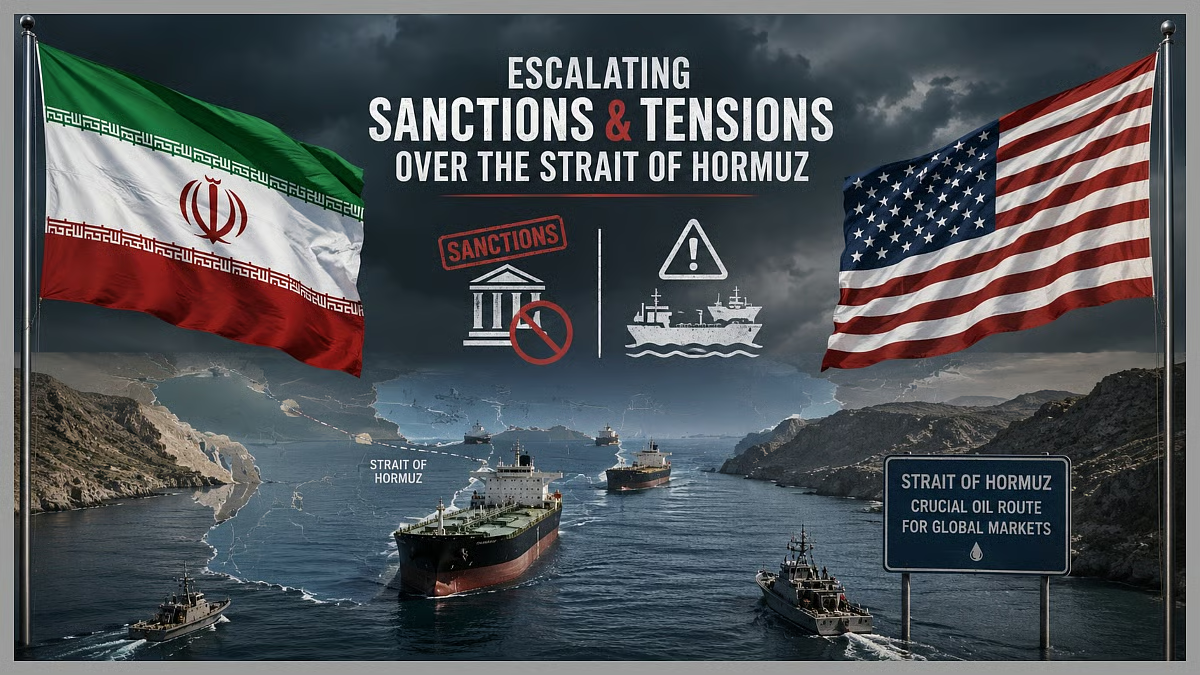
On Monday, the United States went ahead and slapped sanctions on four companies based here in India. The charge is that they were dealing in petroleum and petrochemical products coming out of Iran. This is part of something the Americans are calling “Operation Economic Outcast.” Treasury Secretary Scott Bessent announced it, and the whole idea is pretty straightforward from their side: cut off as many money channels as possible for Iran.
The four names that turned up are Portease Partners LLP, Sadashiva Overseas Limited, PP Softtech Private Limited, and Prakrutees Infra Impex Private Limited. Three Indian nationals are also on the list—Indrismiya Ashrafmiya Sheikh and Harish Ramachandra Rangi, who are partners in Portease, and Prashant Garg, who is a director at PP Softtech.
Portease is a customs broker. The U.S. State Department says it helped bring in multiple shipments of Iranian petrochemical products into India. The other three are accused of actually importing the stuff. Sadashiva Overseas, according to the Americans, brought in about $69 million worth of Iranian-origin petroleum products between February 2024 and June 2025. A good chunk of that came through companies already on the U.S. sanctions list, including one called Bonjoure Commodity F.Z.E. PP Softtech and Prakrutees Infra each allegedly imported around $25 million worth over similar periods. For Prakrutees, the window stretches from May 2023 all the way to February this year.
The official language is that these firms “knowingly engaged in a significant transaction for the purchase, acquisition, sale, transport, or marketing of petroleum or petroleum products from Iran.” Once you’re on that list, American persons and companies are barred from dealing with you. Your assets that touch the U.S. system can get frozen. In practical terms, it makes banking, shipping, and international trade a lot harder.
State Department spokesperson Tommy Pigott put it this way: the United States took sweeping action against multiple entities, individuals, and vessels that enable the Iranian regime’s “destabilising activities.” Those activities, in their view, include attacks on U.S. forces and allies, weapons procurement, cyber stuff, and the sale of energy products that supposedly fund terrorism. Bessent’s team is framing the whole operation as an economic onslaught meant to squeeze Iran’s remaining financial lifelines—oil, petrochemicals, shipping, banking, the works.
Now, from the Indian side, these are not giant oil majors or household names. They are mid-sized players in the import and trading space. The volumes involved—roughly $119 million across the three importers—are not huge in the grand scheme of global energy trade. But the message is clear: Washington is no longer limiting itself to Iranian entities or the big tanker fleets. It’s going after the middlemen, the brokers, the importers, and the customs agents who keep the trade moving.
This is not the first time Indian firms have shown up on these lists. Over the past couple of years there have been several rounds targeting shipping managers, petrochemical traders, and related companies. Each time the pattern is similar. The U.S. says Iran is using a “shadow” network of vessels, intermediaries, and front companies to keep selling oil and products despite the sanctions. India has historically bought Iranian crude and products when the price was right and when diplomatic space allowed it, but the pressure has steadily increased under successive U.S. administrations.
What happens next is the part that matters on the ground. These companies will now find it difficult to open or maintain dollar accounts, get insurance for cargoes, or deal with any firm that has significant U.S. exposure. Banks tend to get cautious very quickly once a name appears on the SDN list. Shipping lines and ports start asking more questions. For the individuals named, travel to the United States and certain other jurisdictions becomes complicated.
India’s official response has been measured so far. New Delhi has long maintained that it follows United Nations sanctions, not unilateral ones, and that its energy security decisions are its own. At the same time, Indian companies that do significant business with the United States or Europe have learned to treat these secondary sanctions seriously. The risk of losing access to the American market or the global financial system is real.
There’s also a wider context. The Trump administration is leaning hard on every country that still has economic ties with Iran. The public messaging is blunt: cut those ties or face consequences. China has already pushed back against the latest package. Other buyers and traders are watching carefully to see how strictly the measures will be enforced.
For the four Indian companies, the immediate task is damage control—talking to lawyers, checking their exposure, and deciding whether to challenge the designations or simply wind down the relevant lines of business. For the rest of the trading community, it’s another reminder that dealing in Iranian petroleum products, even indirectly, carries growing secondary risks.
The numbers involved here are modest compared with the overall volume of Iranian oil that still finds its way to market. But the targeting of relatively smaller Indian firms shows that the net is being cast wider. Washington is signalling that no link in the chain is too small to notice. Whether that actually dries up the revenue streams Iran relies on is a different question. What is clear is that the companies named this week are now carrying the practical weight of that policy.
Sources:
U.S. State Department press release (August 24, 2026); statements by Treasury Secretary Scott Bessent and State Department spokesperson Tommy Pigott; reporting by The Hindu, Economic Times, Times of India, Livemint, Hindustan Times, and other Indian outlets based on the official designations.
@Rohit Manral