
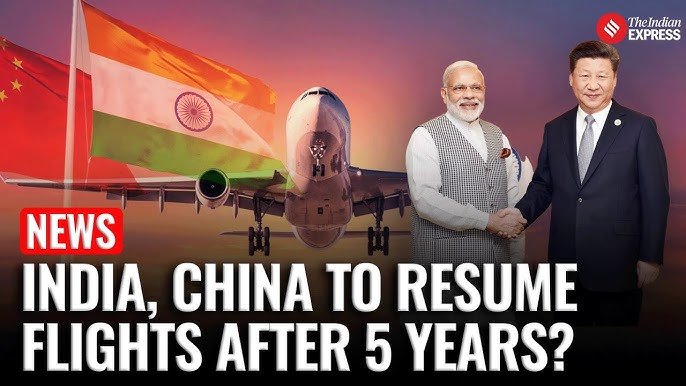
On 2nd of October the Ministry of External Affairs announced to allow the direct flight services between India and China. And just a very short after airline IndiGo announced to continue the daily flights between Kolkata and Chinese international airport of Guangzhou from October 26. Aviation services from Delhi to Guangzhou are also expected to restart soon. Meanwhile AirIndia is expected to restart flights between India and China by the end of this year. The decision comes after the last month visit by Chinese foreign minister Wang Yi to New Delhi. The decision will enable people to people contact between both the neighboring nations improving bilateral relations which were continuously deteriorating for half a decade. The move will improve bilateral exchange of high-value goods like Semiconductors, Pharmaceuticals and Telecom Equipment via Air cargo. The flight operations will need to align with the IATA (International Air Transport Association) winter schedule. We saw the Government’s approach has been to normalize the ties between both the nations from the start of this year. MEA also mentioned in its report that civil aviation authorities of both countries were engaged in technical-level discussions on resumption of air services and a revised air service agreement between both the countries. And the decision by MEA has come as a result of the discussion.
Let’s have a look at why direct flights were put on halt between both countries since 2020
- Covid-19 pandemic-
Due to Coronavirus outbreak at global level in early 2020, travel services were stopped by many countries, imposing travel restrictions and suspending many international flights.
- Disputed border clash –
In 2017, a military confrontation between Indian Army and Chinese PLA (People’s Liberation Army) lasting for more than 2 months over a road construction in Doklam region at the trijunction of India, China and Bhutan. After that in June 2020 a clash happened between Indian Army and PLA at Galwan for the disputed border. 20 Indian soldiers got martyred at least 45 Chinese casualties were reported by Indian sources and media however official Chinese reports claimed only 4 soldiers killed from their side. The Galwan clash intensified the tensions between both countries. As a result, the same year many Chinese apps like TikTok, UC Browser, Shareit were banned in India, regarding concern over national security. Indian government also released PressNote3 which reduced FDI (Foreign Direct Investment) from China to secure Indian companies from Chinese takeover.

- Diplomatic and Strategic reasons–
India and China are vast economies flourishing in the neighborhood and China is always seen as the biggest threat to the growth of India. So, apart from the military factors, to reduce the dependence over China was also one of the reason.
Now, looking at the current scenario-
Many discussions and conferences took place over the years to improve the diplomatic relations after multiple confrontations at Indo-China border. It was in October last year when both the parties agreed to de-escalate border tensions and patrolling was allowed along the Line of Actual Control (LAC).
Then this year in July, External Affairs Minister S. Jaishankar made his first to China for the first time after 2020 and met Chinese President Xi Jinping in Beijing. Jaishankar wrote on X that he spoke about the Indio-China bilateral ties.
And later in August from 18 to 19 Chinese foreign minister Wang Yi visited India on the invitation from National Security Advisor Ajith Doval to co-chair the Special Representatives Dialogue on boundary questions between India and China.
After that on 1st of September Prime Minister Narendra Modi attended the SCO (Shanghai Cooperation) summit taking place in Tianjin, China. The China visit was considered ‘Productive’ by many diplomats and Russian President Vladamir Putin even praised the efforts of both the nations to improve the ties.
As a result now that India’s relations are improving with China, we must also have a look at why China matters to India and how these bilateral relations can help India-
- After US imposed an additional 25 percent tariff on India, India’s inclination towards China and increased engagement of India, China and Russia gave a bigger picture to the potential partnership of three biggest economies in Asian region. The partnership would not only help India in economic growth but also counter the hegemony of US and help India to reduce dependence on US dollar.
- China is one of the largest trading partners of India with bilateral trade reaching approximately $127 billion in FY 2024-25. China is also a global manufacturing hub and India is heavily dependent on Chinese imports for electronical equipment, machinery, mobile phone components and organic chemicals.
- The Indo-China partnership can result in transfer of technology which would enhance Indian manufacturing sector and will reduce India’s reliability on import.
Apart from regional stability and diplomatic causes, the religious sphere also counts as the famous Kailash Man Sarovar Yatra organized by Indian government was stopped by China in 2020. With the improving relations it can be reopened in the coming future.