
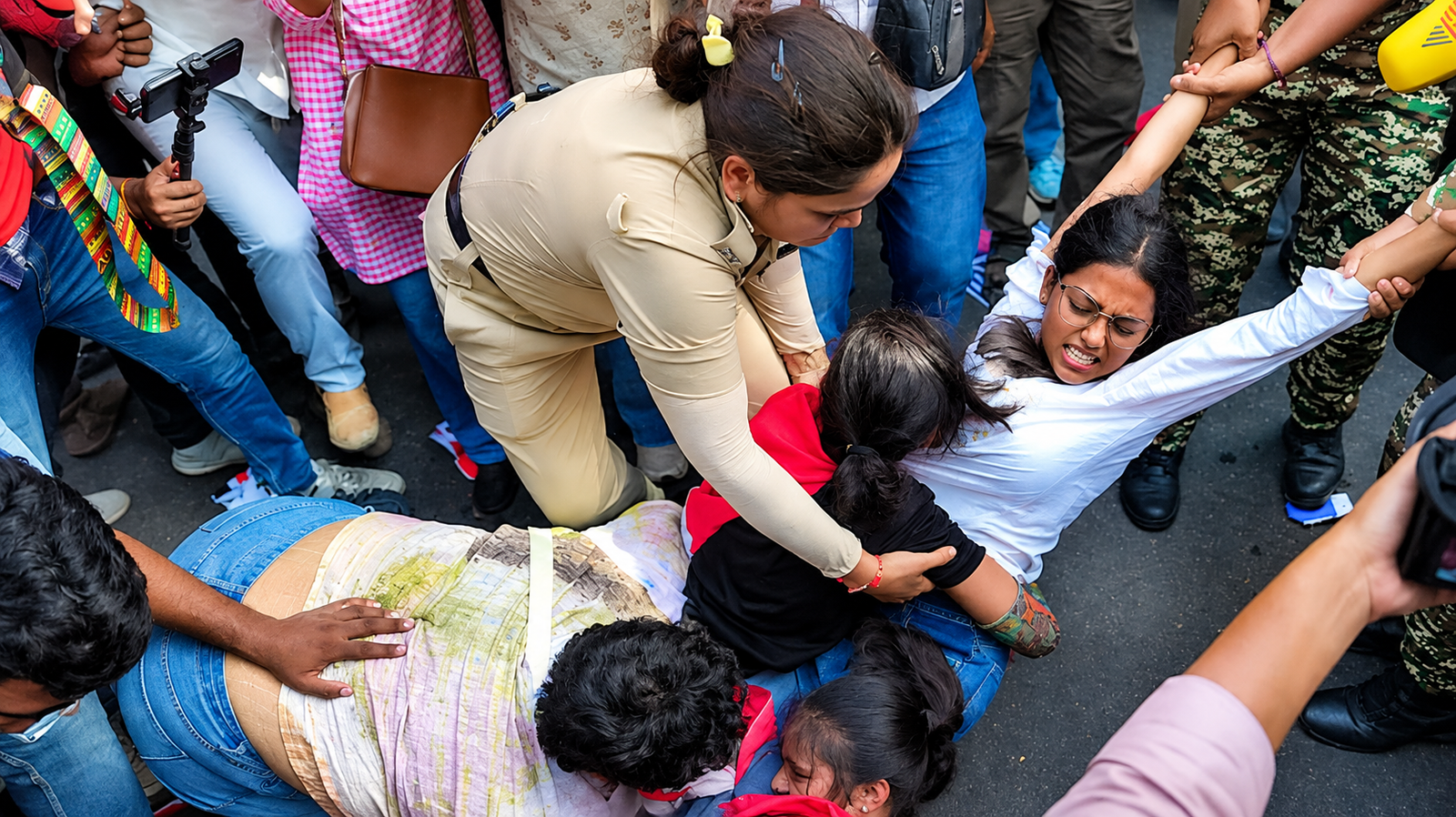
You know how sometimes you hear something and it just sits heavy in your chest? That’s exactly how this whole thing at Jantar Mantar feels right now. On Saturday, while people were out protesting and demanding the resignation of Chief Election Commissioner Gyanesh Kumar over alleged irregularities in the electoral rolls revision process, things turned ugly. Not just the usual push and shove that happens at these places, but something much worse involving women.
Three women journalists covering the protest have come forward saying Delhi Police personnel sexually harassed and groped them. One of them specifically pointed to an Assistant Commissioner of Police, Vivek Bhagat. She said she was simply asking about the absence of women police personnel at the spot while officers were detaining protesters, and that is when the officer allegedly assaulted her and pushed her back. Other journalists and protesters have spoken about cameras being snatched, people being dragged, and general rough handling that went way beyond maintaining order.
Rahul Gandhi did not stay quiet. In a strongly worded post on X, the Leader of Opposition in the Lok Sabha laid it out clearly. He wrote that a female journalist has accused a police officer of misconduct at Jantar Mantar. For hours, hundreds of journalists sat there with just one simple demand — that an FIR be registered. Isn’t that the police’s basic duty? They haven’t even done that. He went on to say that on Saturday alone, hundreds of people were taken into custody. There are allegations of misconduct with women protesters. Cameras were snatched, journalists were dragged. And this isn’t the first time — we’ve seen video evidence of police officers engaging in disgusting misconduct with women earlier.
He didn’t stop there. Gandhi pointed out that women and students across Delhi are gripped by fear for their safety and are staging satyagraha, yet the very police responsible for protecting them are raising hands against them instead. And then he asked the question that many are asking: a government that fears registering even one woman’s complaint — what exactly is it protecting? Delhi Police comes under the Ministry of Home Affairs. Amit Shah ji, where are you? You have to answer for this.
That last bit hits hard because it is true. The Delhi Police reports to the central Home Ministry, so the buck stops there. People have every right to expect answers when allegations of this nature surface, especially involving journalists who were just doing their job of reporting from a public protest site.
The All India Students’ Association (AISA) also raised similar concerns. They said women protesters, journalists and lawyers were manhandled by male police personnel, and several women complained of being groped. There are accounts from the ground of young women being pushed, scratched, and even having clothing pulled during detentions. One senior activist, AISA president Neha Bora, later showed bruises and scratch marks she said she sustained while being dragged into a police bus. She accused policewomen of elbowing protesters and pulling bra straps.
By Sunday, the Delhi Police responded by saying they had received complaints of sexual harassment from three female journalists against police officers during the October 3 protest. The New Delhi district transferred those complaints to the Crime Branch for a fair and impartial enquiry. That is something, at least. But for many who were present, the delay in even registering FIRs when journalists and protesters were demanding it for hours on Saturday felt like a deliberate stalling.
This is not happening in isolation. Jantar Mantar has seen repeated clashes and allegations of excessive force in recent months, whether during student protests over exam paper leaks or other public agitations. Each time, the same questions come up about the handling of women protesters and the space given to journalists. When the police are meant to protect citizens’ right to peaceful protest and the media’s right to report, incidents like these erode trust very quickly.
What makes this particularly troubling is the vulnerability of the women involved. Journalism is already a tough job in charged atmospheres. Adding physical misconduct and the subsequent struggle just to get a complaint registered turns it into something much darker. The journalists who staged the sit-in were not asking for special treatment. They were asking for the law to take its course — an FIR, an investigation, accountability. That should not require hours of waiting or public pressure from senior political leaders.
Rahul Gandhi’s intervention has brought the issue into sharper focus, as expected. As Leader of Opposition, he is doing what the role demands — holding the government answerable for the conduct of a force that falls under its direct control. Whether the Crime Branch enquiry will be swift and transparent remains to be seen. People will be watching closely because these kinds of allegations cannot be brushed under the carpet or allowed to drag on indefinitely.
In the end, this is about basic dignity and the rule of law. Women should be able to protest or report from a protest without fear of being groped or manhandled by those in uniform. Journalists should not have to fight for hours just to get an FIR registered when they allege assault. And the Home Minister, under whose ministry the Delhi Police functions, owes the public a clear response. The enquiry has been ordered. Now it needs to be done properly, without fear or favour, so that those who crossed the line — if the allegations are proven — face consequences, and those who were wronged get justice. Anything less will only deepen the sense that some voices matter less than others when power is involved.
Sources:
ABP Live / PTI report (4 Oct 2026)
India Today (4 Oct 2026)
Hindustan Times (4 Oct 2026)
LiveMint (4 Oct 2026)
The New Indian Express (4 Oct 2026)
National Herald (4 Oct 2026)
ANI report (4 Oct 2026)
@Rohit Manral