
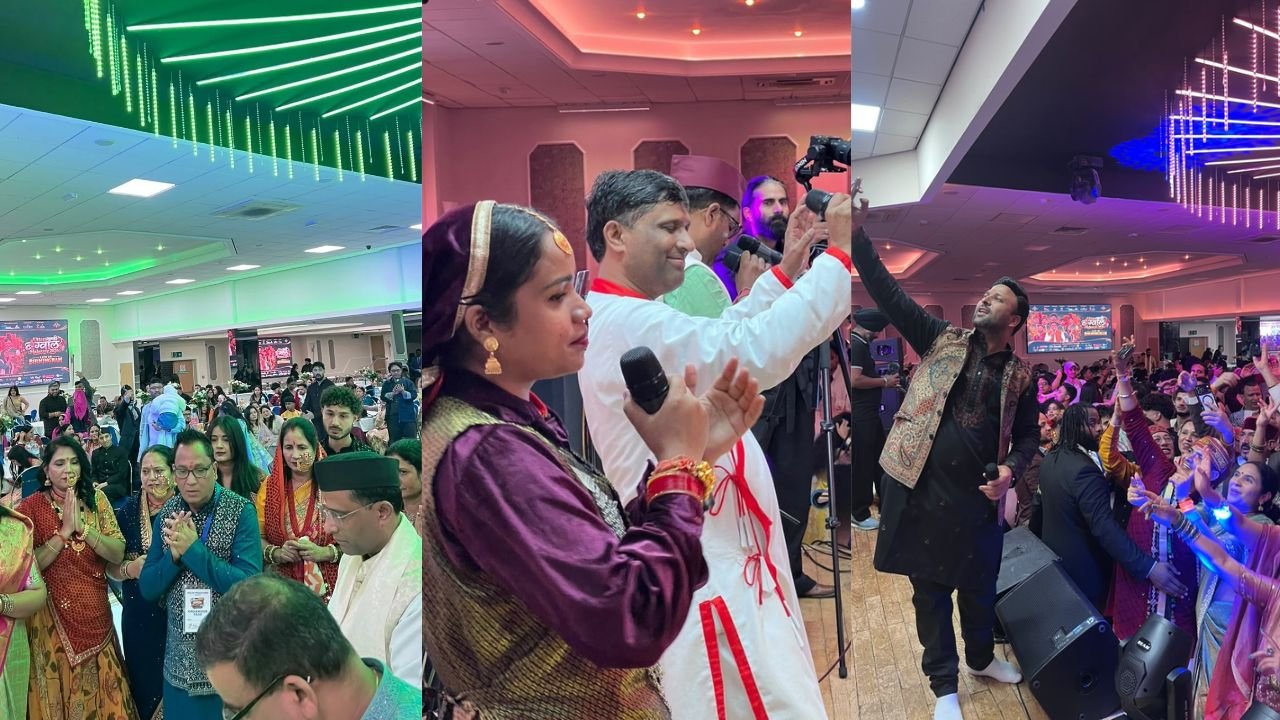
Birmingham, UK – Last week the hall still smelled of pahadi food when people started coming in. Most of them left the mountains years ago. Some drove for hours. Others took early trains. They came because Padma Shri Dr. Pritam Bharatwan was performing. Everyone still calls him Jagar Samrat — the man who has kept the traditional Jagar and Pawada of Garhwal and Kumaon alive for decades.
The Uttarakhand Welfare Organisation and Shilpa Production put the evening together. When Bharatwan walked on stage and started the old Jagars and Pawanras, the room went quiet the way only people who know those songs go quiet. Then the clapping began — soft at first, then louder. It was the kind of clapping that comes from recognition, not politeness.
His voice still carries that mountain air. He sang about the gods, the fields, the rivers, the long winters. For a lot of people in the audience it wasn’t just a concert. It was the sudden smell of pine and woodsmoke again. The sound of dhol-damau across a village evening. Several people said afterwards they had tears without noticing until later.
The moment that really lifted the hall was when Pritam and his brother Surtam picked up the dhol and damau. Those deep beats filled the place and people stood up. Some danced in the aisles. Others just swayed and smiled the way you smile when something old and familiar suddenly feels close again. The energy stayed high right through the night. Guests including Anjali Khare, Surtam Bharatwan and popular Garhwali singer Vivek Nautiyal were there. Nautiyal, known for hit songs like Dyo Laagi, Ramjhama and Udija Chakhuli, sat with the audience and joined the applause that kept coming. The organisers made sure the artistes and their team were properly welcomed and felicitated.
Afterwards Bharatwan spoke the way he always does — straight. He told the diaspora to keep speaking Garhwali and Kumaoni at home. Teach the children the old songs. “Staying connected with our language and culture is not just about nostalgia,” he said. “It is about knowing who we are and respecting the roots that hold us.” People listened without fidgeting.
He thanked the organisers, the volunteers, and everyone who turned up. Bharatwan has performed in America, Australia, Europe — university stages and community halls alike — but nights like this one in Birmingham still matter to him. They show the folk traditions haven’t thinned out just because people live far from the hills.
During the same UK trip he also spent time in London meeting more of the community and carrying the same message. For a man who has spent his life keeping Jagar, Pawada and the dhol-damau tradition alive, these journeys are more than shows. In 2019 he received the Padma Shri for exactly this work. He has recorded hundreds of songs, started teaching centres back home, and keeps travelling so the next generation — whether in Dehradun or Birmingham — still hears the sound of their own soil.
What stayed with people was how simple the evening felt. No big production. No electronic beats trying to modernise everything. Just two brothers with traditional instruments singing the songs the land gave them, and a hall full of people who still carry those songs. In a time when so much culture gets flattened or packaged, nights like this feel rare and necessary.
The organisers from Shilpa Production and the Uttarakhand Welfare Organisation did the hard, quiet work of bringing him across, booking the venue and gathering the community. The turnout and the look on people’s faces showed it was worth it.
Shilpa Bhatt, founder of Shilpa Production, said the response in Birmingham had only strengthened her resolve. To promote Uttarakhand culture across the world, she plans to organise more such events in the future, bringing the music, language and traditions of the hills to diaspora communities wherever they are. Pritam Bharatwan welcomed the commitment. He said sustained efforts like these help keep the living traditions of Garhwal and Kumaon alive far beyond the mountains.
For many in the diaspora the evening will stay. Some will dig out old recordings. Some will start teaching their children a few lines of a Jagar. A few will just sit with tea the next morning and feel a little less far from home.
Pritam Bharatwan showed again that the music of the hills doesn’t need translating. It reaches the heart whether you are sitting in a courtyard in Tehri or a community hall in Birmingham. And as long as people keep gathering like this, the old songs will keep travelling — generation after generation, ocean after ocean.
Sources:
Garhwal Post, 29 October 2026
Avikal Uttarakhand, 27 October 2026
Additional details from community accounts and the artiste’s known work.
@Rohit Manral