
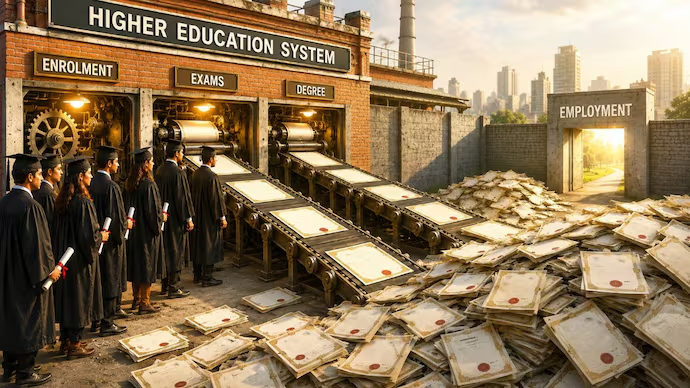
A new Niti Aayog paper says only 8.25 percent of graduates are in jobs that match their qualifications. That number hits hard. The paper is called Reimagining Skilling for Viksit Bharat @2047. It came out a few days ago. It doesn’t just say “unemployment is high.” It points to something more uncomfortable — the big gap between what colleges teach and what the job market actually wants.
Look at how many students are stuck in the same three courses. Out of roughly 3.4 crore undergraduates, more than two crore are doing BA, BSc or BCom. BA alone has over a crore. These have become the default choice for so many families. They keep the government job door open, at least on paper. But the report is clear: these generic degrees rarely lead to real work. Even a simple entry-level job often needs practical skills — Tally, basic computer applications, something hands-on — that never got taught properly in class.
Finance Minister Nirmala Sitharaman said almost the same thing recently. Most courses, she pointed out, don’t ready students for jobs and don’t prepare them to start anything of their own either. Someone finishes a BA in economics or political science and then what? Often another degree. Even after a master’s the path stays foggy unless they somehow pick up extra skills on the side.
Students feel this every day. The paper notes that 34 percent of them say lack of skills is a major problem while they are still studying. Another 18 percent talk about not knowing how to face interviews. And a massive 80 percent of higher education students say they miss practical experience and real industry exposure. They learn the theory. The practical part is left for “later,” and later never really comes.
That is why the rush for government jobs is still so intense. Between November 2024 and July 2025 nearly 1.86 crore applications came in for just 55,000 posts. The numbers themselves tell the story. The education system raises big hopes for secure work, but the actual supply of those jobs is tiny. Private companies, meanwhile, keep asking for experience that fresh graduates simply do not have.
The report also looks at the quieter problems. Many courses remain outdated. Teachers sometimes teach new subjects without enough real industry exposure themselves. The facilities for practical learning are weak in too many places. Internships and apprenticeships exist on paper, but too often students just sit and watch instead of actually doing the work. Very few ITI trainees move into proper apprenticeships. Most small and medium businesses, which create a large share of jobs, barely take on apprentices under the current schemes.
Niti Aayog’s suggestions are not the usual “train more people” talk. They want the focus to shift from how many get trained to whether that training actually leads to jobs, better pay and real career movement. One strong idea is to start early. Bring in basic employability and entrepreneurship skills from Class 6 itself. From Class 9 let students choose specialised skill tracks linked to what the local and national job market needs. In colleges, expand degrees and diplomas that include real apprenticeships so students learn while they work. Make apprenticeships a normal path, not an afterthought.
They also want a change in how people get hired. Try skills-first hiring in some public sector roles and high-volume jobs. Look at what a person can actually do, their ITI or apprenticeship credentials, their work experience — rather than insisting on a degree when the law does not require it. Take degree requirements off job ads where they are not necessary. The simple line the paper uses is: select by skills, not degrees.
All of this sits against a bigger picture. Technology is moving fast. AI, automation, the shift toward greener work — all of these are changing what employers want. Digital skills and communication remain weak spots for many. At the same time India has a labour force of about 65 crore people and nearly 29 crore students still inside the education system. Most people work for themselves. Regular salaried jobs form a smaller share. The system needs to let people move between school, college, skill training and work without starting from zero every time. None of this is completely new. Graduate unemployment has stayed high for decades even as more people went to college.
For the millions walking out of colleges every year the question is plain. They did what was asked of them. Now the system has to catch up so those years of study actually lead somewhere useful.
Sources:
NITI Aayog, Reimagining Skilling for Viksit Bharat @2047 (August 2026)
Economic Survey 2024-25
India Today reports, 20–21 August 2026
ThePrint coverage, 20 August 2026
Ministry of Skill Development and Entrepreneurship, State of Skills Survey 2024
@Rohit Manral