
Right now, in Delhi, climate activist and education reformer Sonam Wangchuk is sending out a powerful handwritten note from what he and his supporters are calling “illegal detention” at Safdarjung Hospital. He’s framing the ongoing protests as Azaadi ka Doosra Andolan – India’s second freedom movement. And honestly, it’s making a lot of us pause and think.
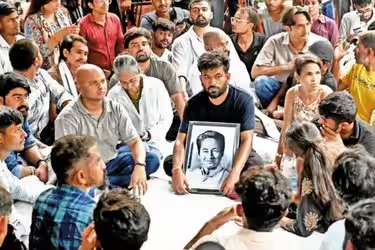
Picture this: Sonam Wangchuk, the guy from Ladakh who’s spent years teaching kids, building ice stupas to fight water scarcity, and pushing for real environmental sense in the Himalayas, has been on an indefinite hunger strike at Jantar Mantar. For over 20 days, he and young protesters from the Cockroach Janta Party have been raising their voices against the mess in our education system – those heartbreaking paper leaks in NEET and IIT-JEE, the insane coaching fees that crush middle-class families, the student suicides that keep happening, and the bigger question of accountability. They want the Education Minister to take responsibility and fix things.
Then, on Saturday, things took a turn. Delhi Police moved him to Safdarjung Hospital on medical advice and court orders as his health weakened. His wife, Gitanjali Angmo, and supporters say it felt forced – that he wanted to continue the fast until the big Parliament march on July 20. They call it illegal detention because his movements are restricted, with police presence limiting visitors and family. Wangchuk’s family has even approached the Delhi High Court, expressing lost faith in the hospital setup and seeking his transfer.
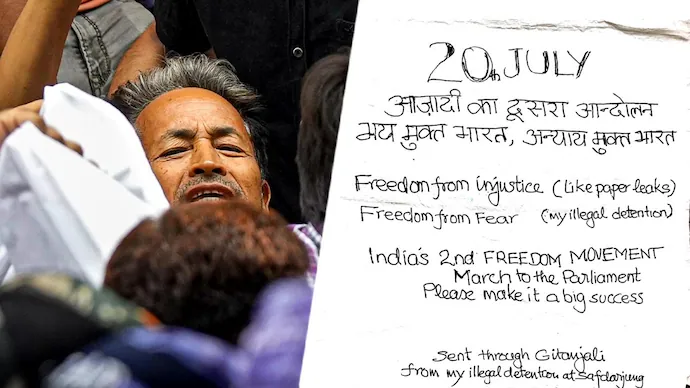
From that hospital bed, through Gitanjali, Sonam sent out a message that feels straight from the soul. Dated July 20, it reads something like: “Aazaadi ka doosra andolan, bhay mukt Bharat, anyay mukt Bharat.” Freedom from injustice – like the paper leaks that destroy young dreams. Freedom from fear. He urges everyone to make the “Chalo Sansad” march to Parliament a massive success. It’s not just about exams, he seems to say.
Sonam isn’t some distant politician. He’s the innovator who showed Ladakh how to store winter water as ice for summer. He’s fought for tribal protections and statehood for his region after Article 370 changes. Earlier this year, he was detained for months under the National Security Act over Ladakh protests, only released in March. Now he’s back in the spotlight, but on a national stage about education.
The response has been electric. Opposition leaders like Rahul Gandhi and Arvind Kejriwal have called the police action arrogant and wrong. Supporters at Jantar Mantar erupted in emotion – there are stories of ink being thrown in protest. The Cockroach Janta Party vows to continue, even starting a new hunger strike. Youngsters are showing up because this feels personal: their futures, their parents’ savings, the pressure cooker of competitive exams.
But let’s be real. Not everyone sees it the same. Some voices, especially from the ruling side, have questioned the protests or even thrown around strong labels. Yet, the core issue – systemic leaks, unaffordable education, mental health crises among students – is something almost every Indian family has felt.
Sonam’s message from the hospital isn’t fiery rhetoric. It’s handwritten, calm, and direct. He’s calling it India’s second freedom struggle – not against foreign rule this time, but against internal injustices that erode trust. Freedom from a system where fear of speaking up keeps people quiet. Freedom from an education setup that feels more like a lottery than merit. It’s a call to march peacefully on July 20, to show up for the kids, for the future.
As someone who’s followed these things, I feel a mix of hope and worry. Hope because people are waking up to connect the dots – Ladakh’s environmental battles, education reforms, democratic rights. Worry because prolonged protests and detentions can spiral. Health concerns for Sonam are real after 20+ days without food. Hospitals should heal, not become sites of political tug-of-war.
This moment feels bigger than one man. It’s about whether we can have honest conversations about fixing what’s broken without labeling each other. Sonam Wangchuk’s journey – from ice stupas in freezing Ladakh to fasting in Delhi heat – shows the power of persistence. His wife and team are fighting legally for his well-being while keeping the message alive.
The July 20 march will be a test. Will it draw thousands? Will it stay peaceful? Will it force real dialogue on exam security, regulation of coaching centers, and mental health support? I hope so. Because our kids deserve better than fear and leaks. They deserve a Bharat that’s just and fearless. In the end, Sonam’s note is an invitation to each one of us. Not to shout, but to show up – in our own ways – for a country that lives up to its promises. As he sits in that hospital room, his words travel farther than any speech.
Sources:
- India Today, Economic Times, Moneycontrol reports on Sonam Wangchuk’s message and hospital events (July 19, 2026).
- Social media shares of the handwritten note via Gitanjali Angmo.
- Background on protests from CNN-News18, Al Jazeera archives on prior detentions.
- Public statements from opposition leaders and CJP.