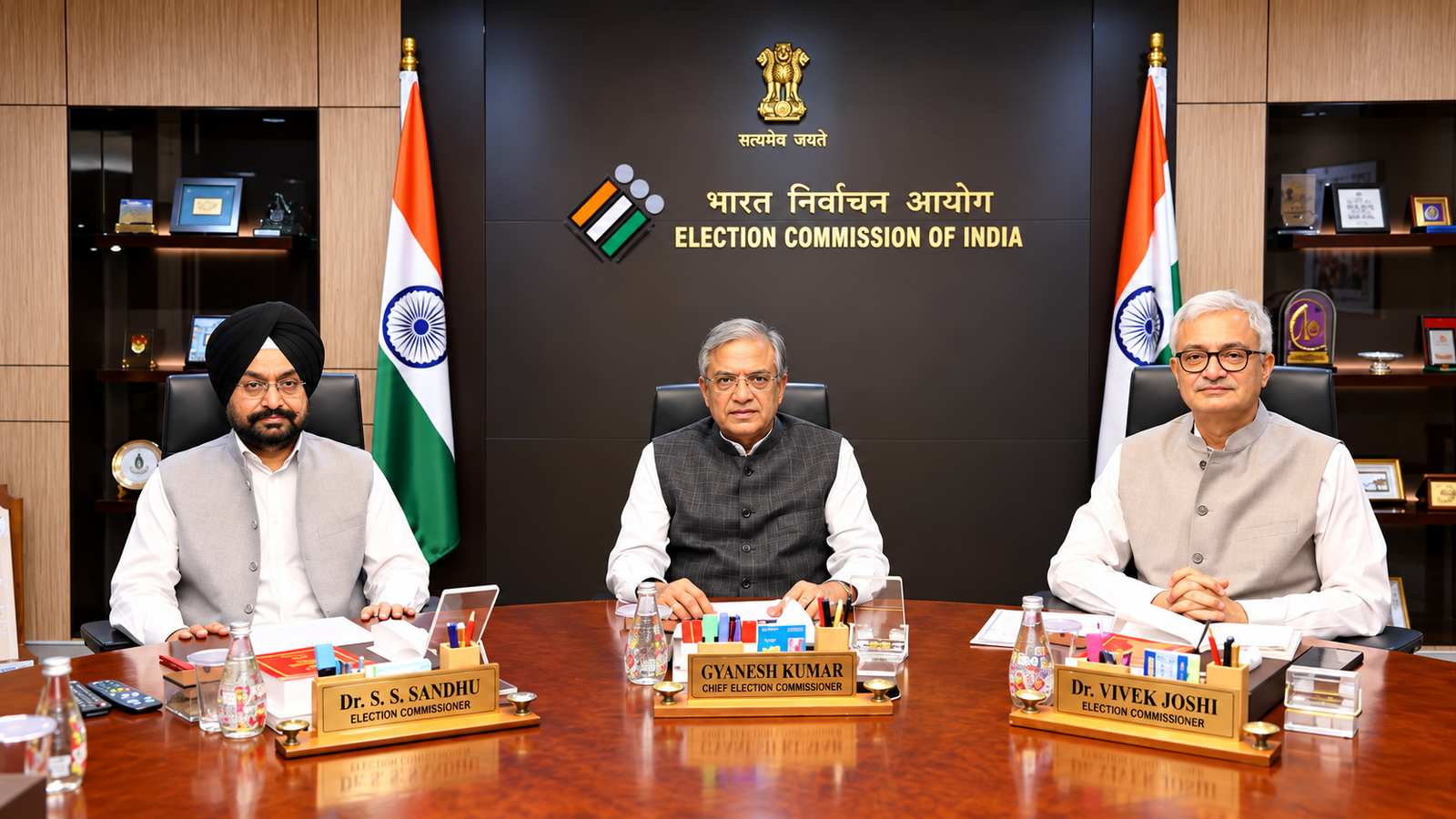
New Delhi: In a quiet but significant climbdown, the Election Commission of India has finally taken off that extra declaration from the online Form 6 in states where the Special Intensive Revision of electoral rolls has already finished. The same change that two of its own Election Commissioners had repeatedly labelled “illegal” and “unauthorised” is gone from those places.
For months this little addition had been sitting right there on the ECINET portal. Anyone filling Form 6 to get their name on the voter list suddenly had to answer whether they, or their parents, or even their grandparents, figured in the electoral roll prepared during the last intensive revision. If yes, they had to dig out booth number, serial number, the whole lot. Young people trying to register for the first time found themselves stuck. Many simply did not know the details and could not move forward on the form.
Election Commissioners Sukhbir Singh Sandhu and Vivek Joshi had seen the problem coming. Way back in May, when the idea was first floated as part of the SIR framework, Vivek Joshi put it on file in clear words. Form 6 is a statutory form fixed under the Registration of Electors Rules, 1960. You cannot just tinker with it through an internal order or a portal update. The proper way is to send the proposal to the government so the rules themselves can be amended. Sandhu agreed with him a few days later.
Yet in July the declaration quietly appeared on the online form. Applicants could not skip it. The downloadable paper version of Form 6 remained untouched, which only made the whole thing look messier. On 13 August, after reading about it in the newspapers, Sandhu wrote another strong note. He pointed out that despite the two Commissioners’ clear views, the “unauthorised/illegal changes in Form-6 on the portal” were still there. He asked for them to be removed at once so that young and first-time voters who were otherwise eligible could register without harassment.
Nothing happened for weeks. The form kept asking the same question.
Then last week The Indian Express published a detailed investigation showing that Sandhu and Joshi had recorded objections at least fourteen times over ten months on various SIR-related decisions. The Form 6 issue was one of the sharpest flashpoints. Former Chief Election Commissioner O.P. Rawat called the change “absolutely wrong and illegal.” Others who have served in the Commission also said the same thing: a statutory form cannot be altered by the Commission on its own.
Facing the heat, the full Commission met on 26 September. After the meeting the Election Commission put out a note saying the declaration attached to Form 6 was meant only for the SIR period. For non-SIR periods the forms prescribed under the 1960 Rules would be used. A few nights later, on 29-30 September, the extra declaration disappeared from the ECINET app and portal in all those states and Union Territories where the final SIR rolls have already been published. In the states where the revision is still going on, the declaration remains for now.
The Commission has maintained throughout that it never amended Form 6 itself. It only added an SIR-specific requirement, and it claims the Supreme Court upheld that approach while hearing the Bihar SIR matter. Critics, including the two Commissioners on the inside, have argued that slipping the declaration into the online Form 6 process still amounted to changing a statutory form without following the law.
For ordinary people the practical difference is simple. In states where SIR is over, a first-time voter can now fill the regular Form 6 without having to hunt for grandparents’ old electoral details. That was the exact worry Sandhu had flagged months ago.
This episode has also pulled the curtain back on how decisions have been taken inside the Commission over the past year. The two Commissioners have said, in writing, that several orders went out without their knowledge. Control over the electoral-roll software was centralised in ways that limited what field officers could do. Appeals and deletions happened on a large scale without full consultation. The Commission’s public response has been that differences of opinion are normal and that all decisions were collective.
Whether this latest correction closes the matter or not remains to be seen. Opposition parties have already demanded a fuller explanation and even judicial scrutiny. For the moment, though, the form that young Indians use to claim their right to vote has been restored, at least in the places where the big revision exercise is finished.
It took months of internal notes, newspaper reports, and public criticism for the change to be walked back. That itself tells a story about how the institution has been functioning.
Sources:
The Indian Express investigation (23 September 2026) and follow-up reports; India Today; Firstpost; The Wire; The Tribune; Economic Times; PTI dispatches on the 26 September Commission meeting and the subsequent portal update.
@Rohit Manral