
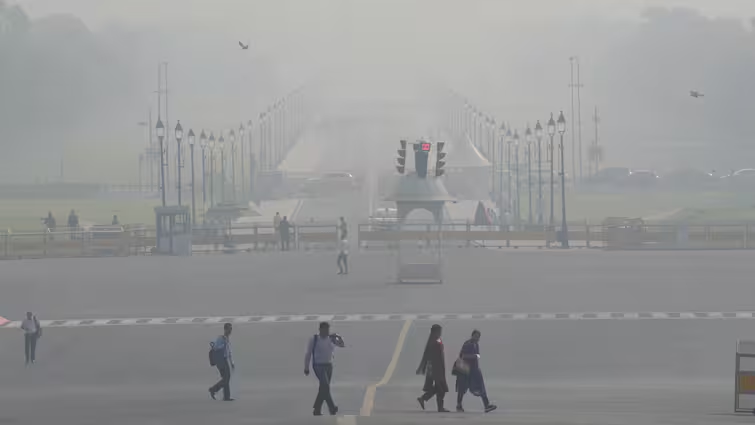
The air quality of Delhi has again dipped to toxic levels. On Thursday, the general Air Quality Index (AQI) of the city was 352, which comes under “very poor” to “severe” category. It shows that the air is not safe to breathe in, particularly for children, the aged, and those suffering from respiratory issues. The government attempted to use a new technique called cloud seeding recently — an artificial rain that was supposed to purify the air. However, the plan failed, and pollution levels are still high.
What is Causing the Pollution?
Every year at this time, Delhi suffers from the same problem. Crop residue burning in adjoining states of Punjab and Haryana emits smoke, exhaust of vehicles, industrial emissions, and construction dust combine to create a toxic brew. Because of low temperatures and slow wind speed, these pollutants get trapped close to the ground. The result is the typical smog cover that is hard to inhale and reduces visibility over the city.
What Is Cloud Seeding?
Cloud seeding is a scientific technique that tries to create rain man-made. The idea is to atomize certain chemicals — usually silver iodide or sodium chloride (salt) — into clouds using airplanes. The chemicals induce water droplets to form, which become rain. If it works, the rain can purify the air by clearing out small polluting particles like PM2.5 and PM10, some of the most harmful of pollutants.
The Delhi government, with researchers from IIT Kanpur, tested the first cloud-seeding experiment this week. Aircraft took off from points such as Khekra, Burari, and Mayur Vihar for a period of about 30 minutes and released eight flares containing special chemicals. Authorities were counting on rain to come in a matter of hours but that did not happen.
Why It Failed
Experts say cloud seeding will succeed only when there are enough moisture-charged clouds in the air. Unfortunately, during the trial, Delhi skies’ clouds did not have enough water content — just 10–20%, while at least 50–60% is needed to trigger effective rains.
Thus, no rain actually occurred and the pollutants lingered. There was some reduction in pollution levels in some areas — for example, Burari and Mayur Vihar PM2.5 levels went down by a bit — but not sufficient to actually make an impact.

Generally, the weather just wasn’t right for cloud seeding to be effective.
Why Cloud Seeding Isn’t a Long-Term Solution
While the experiment was creative, most scientists agree that cloud seeding can only offer temporary relief — and only if it actually rains. Even then, the air gets dirty again within a few days if pollution sources continue.
The bigger problem is that Delhi’s pollution comes from multiple sources:
- Vehicles releasing harmful gases.
- Factories and power plants burning fuels.
- Construction sites creating dust.
- Farmers burning crop waste in nearby states.
Unless these issues are solved, no quick fix — not even artificial rain — will clear the air for long. Here are a few steps Delhi residents can take for their safety: Check the AQI apps before heading outdoors.Keep the windows closed during hours of high pollution.
What’s Next?
Officials are hoping that at least one of these attempts will lead to real rain that can bring some relief. But even if that happens, experts stress that real change will come only from long-term solutions — stricter pollution control, cleaner public transport, better waste management, and strong laws against stubble burning.

The Bottom Line
Delhi is once again struggling to breathe. The failed cloud-seeding experiment shows the futility of combating pollution with quick fixes. Progress, if it is to happen at all, would take time, planning, and coordination between the central government, state governments, and citizens. Till then, Delhi’s residents will have to continue waiting and hoping for cleaner skies.