
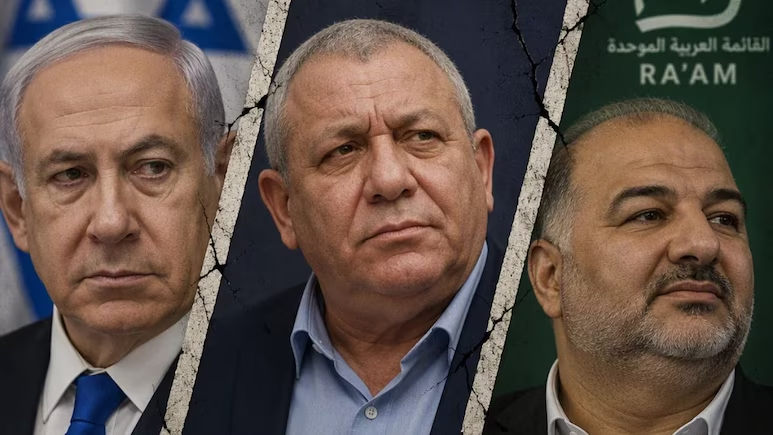
Israel’s election has left the country in a familiar mess. Benjamin Netanyahu’s right-wing bloc has come out ahead but still short of the 61 seats needed to form a government. The opposition led by former army chief Gadi Eisenkot is further behind. And right in the middle sit the two Arab parties, which have just scored their best result in years and now hold the balance of power.
With the count nearly complete, Netanyahu’s alliance is sitting on around 53 seats. Eisenkot’s camp has about 48. The Joint List and Ra’am together have 19 — 12 for the Joint List and seven for Ra’am. That is a big jump from the 10 they held in the last Knesset and higher than the previous record of 15 set back in 2020.
Arab citizens make up roughly a fifth of Israel’s population. This time they turned out in unusually high numbers, somewhere between 75 and 80 percent in many towns. People in places like Umm al-Fahm, who often stayed home in previous elections, showed up. The anger at Netanyahu’s government, especially at far-right ministers Itamar Ben-Gvir and Bezalel Smotrich, clearly played a part.
Netanyahu has already started pushing back. He claims there was serious fraud in Arab areas and says his party has sent hundreds of testimonies to the elections committee and the Shin Bet. No solid evidence has been made public yet, but the charge is out there and it raises the temperature.
On paper the math is simple. Add the Arab parties’ 19 seats to Eisenkot’s 48 and you get 67 — more than enough for a majority. But politics is never that simple here. Most of the Jewish parties in the opposition spent the campaign saying they would not rely on Arab parties to form a government. They talk about different values and different views on the nature of the state. Eisenkot himself has been careful, saying any cooperation would come with conditions.
Mansour Abbas of Ra’am has said he is open to joining a government that can get to 61. The Joint List has talked about providing outside support without sitting in the cabinet. Ahmad Tibi has already indicated his party would back an opposition candidate for Knesset speaker. That alone could give the anti-Netanyahu side control of the agenda in the early days of the new parliament.
If Netanyahu cannot form a government and ends up out of office, the consequences for him are serious. The long-running corruption cases would move forward. And there would almost certainly be a formal inquiry into the security failures around the 7 October 2023 attack. That is one reason he is fighting so hard to stay in power.
The next few weeks will be messy. President Isaac Herzog will soon hand the mandate to one of the leaders to try to build a coalition. Netanyahu will look for any small party that might peel away from the opposition. Eisenkot will have to decide how far he is prepared to go with the Arab parties. There is also the possibility of a unity government or even another election if nothing works.
For Arab voters the result is a clear message. They turned out, they voted, and now their representatives have real leverage. Whether that leverage turns into actual influence is another question. Israeli politics has a long history of treating Arab parties as outsiders, even when the numbers say otherwise.
Right now the country is stuck. Neither of the big blocs can govern alone. The Arab parties sit in the middle with more seats than they have ever had. How the Jewish parties respond to that reality will decide who leads Israel next — and how long the current political deadlock lasts.
Sources:
The Times of Israel, 28-29 October 2026
Fox News, 29 October 2026
NDTV, 29 October 2026
BBC News and other Israeli and international reports on the partial and near-final results
@Rohit Manral