
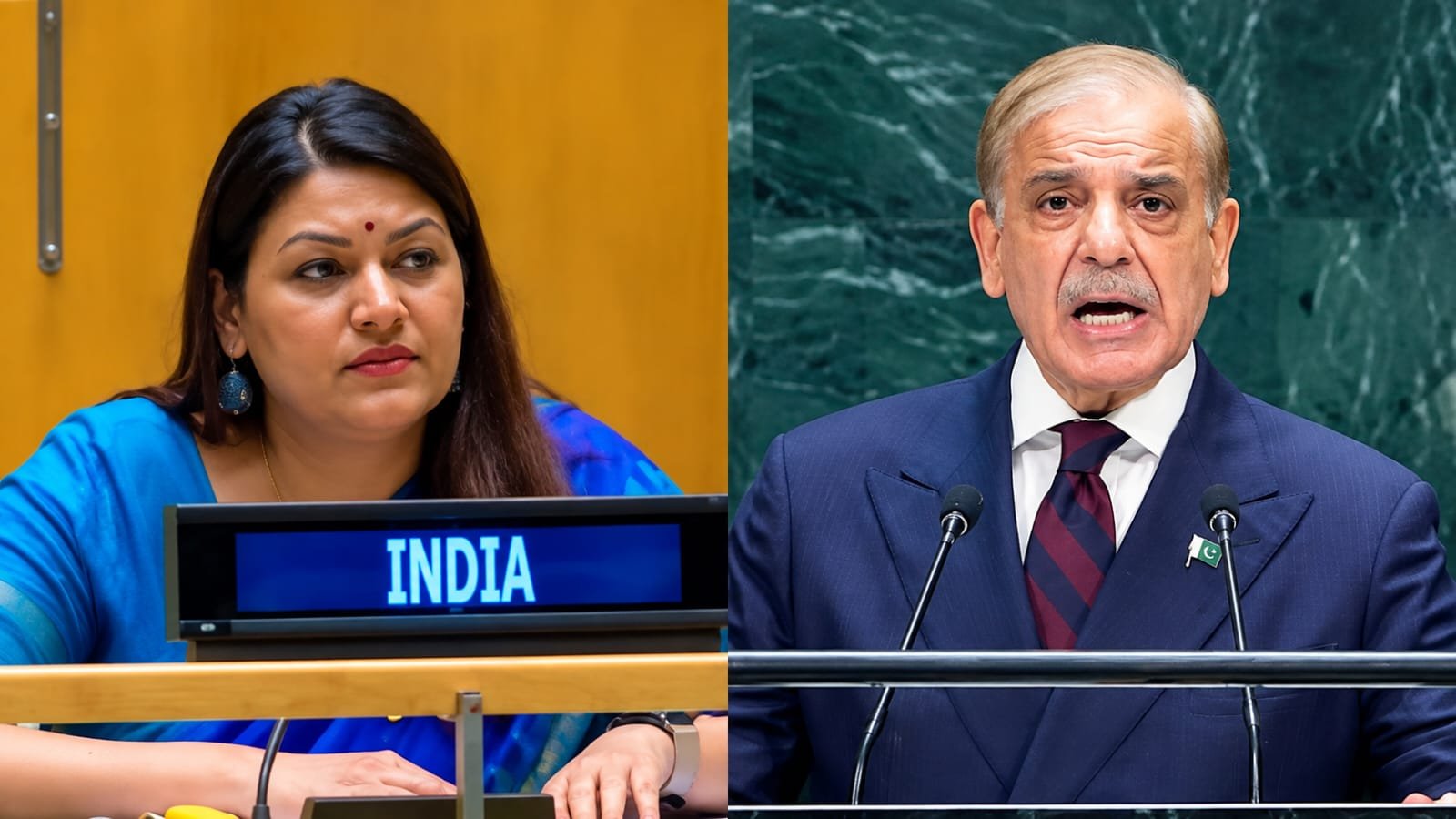
Last week Pakistan’s Prime Minister Shehbaz Sharif stood up there and did what Pakistani leaders usually do. He spoke about Kashmir, thanked Donald Trump for stepping in during last year’s fighting with India, and said any attempt by India to mess with the Indus waters would be treated as an act of war. Familiar stuff. We’ve heard versions of it for years.
The next day India answered. Not with a long speech or drama. Just a clear, steady reply from First Secretary Petal Gahlot. She took the floor under the Right of Reply and didn’t waste time.
She started by calling the remarks bizarre. Then she pointed out the timing. Only two weeks earlier New York had marked twenty-five years since 9/11. And the man behind those attacks, Osama bin Laden, had lived for years right next to Pakistan’s top military academy. That detail still hangs in the air every time Pakistan talks about security.
Gahlot didn’t stop there. She said Pakistan talks about protecting people by day and then supports terrorism by night. She described the system there as a regime of the army, by the army, and for the army. Leaders come and go, she said, but everyone knows who really runs things. She even mentioned the 27th Amendment and the lifelong protection it gives to the actual power centre.
On Kashmir she was direct. Jammu and Kashmir is part of India. It always has been and it always will be. If the world wants to talk about Kashmir, she said, then look at the side under Pakistani control. Ask the people in places like Rawalakot what they’ve faced — the violence, the killings, the everyday denial of basic rights.
The real point she kept coming back to was cross-border terrorism. India showed last year, she said, that terrorists will not have safe places to hide. “Our right to defend ourselves against terrorism will be exercised. And continued terrorism by Pakistan will have consequences.” Those words were quiet but they landed. She added that this kind of continued terror would naturally call into question any idea of friendship or goodwill between the two countries.
She also pushed back on the lectures about religion and human rights. This, she said, from a country that leans so heavily on blasphemy laws, and where the treatment of minorities is already well known. Nice words don’t change that picture.
Sharif had raised the Indus Waters Treaty too. India has kept the treaty on hold since last year, saying Pakistan’s support for terrorism made normal cooperation impossible. Sharif called any interference with Pakistan’s share of the water an act of war. Gahlot didn’t get into long arguments about rivers. Her larger message was simple: you can’t talk about friendship while terror keeps coming across the border.
These exchanges at the United Nations have become almost ritual. Both sides know the lines. Both sides deliver them. For people living on either side of the border, the speeches rarely change daily life. The Line of Control stays tense. Families still wait for news that never comes. Trade stays limited. Yet the language still matters. When an Indian diplomat stands in that hall and says terror will have consequences, it is a clear signal that the old rules have not changed.
Later, External Affairs Minister S. Jaishankar backed the same point in India’s formal statement. He spoke of a “serial practitioner of terrorism” who tried to twist the facts and claim protection from the results of its own actions. That will not stand, he said. India’s right to defend itself remains firmly in place. Friendship and goodwill cannot sit alongside terror.
India has said for a long time that real talks only make sense when the cross-border terror stops. Pakistan keeps insisting Kashmir is the core issue and that water must never be used as a weapon. The distance between those two positions has not narrowed. If anything, this latest exchange shows how little common ground either side sees right now.
Gahlot’s reply was not loud or theatrical. It was calm, specific, and firm. That may be why it cut through. In a place full of long speeches and repeated talking points, a short reminder that actions carry costs still gets heard.
Whether that message reaches the people who make decisions in Islamabad is another matter. For now the record is clear. India has said it again, in public, on the biggest stage available: terror will have consequences.
Sources:
India’s Permanent Mission to the UN, Right of Reply by First Secretary Petal Gahlot, 81st UN General Assembly, September 2026
External Affairs Minister S. Jaishankar’s national statement at the UN General Assembly, 26 September 2026
Reporting from The Hindu, India Today, The Tribune, NDTV, Indian Express and PTI, 26-27 September 2026.
@Rohit Manral