
Yesterday, Congress leader Priyanka Gandhi Vadra was speaking about on Tuesday when she tore into BJP MPs for the way they welcomed Dharmendra Pradhan back into Parliament.
Just two days after Pradhan resigned as Education Minister, some of his party colleagues in the Parliament complex greeted him with a traditional cap, a stole, and loud slogans of “Pradhan Zindabad.” They treated him like he’d just returned from winning a big match. Priyanka didn’t hold back.
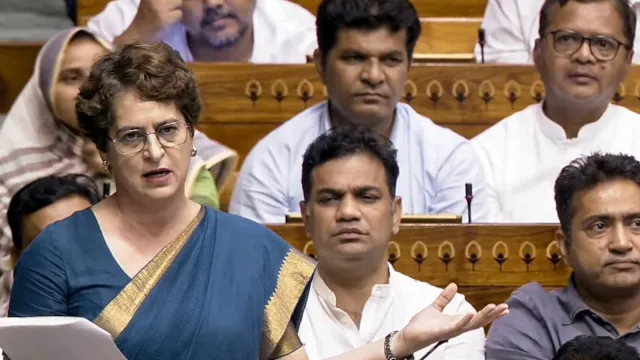
“Don’t you think it is shameful?” she asked. “Everyone saw the circumstances under which Dharmendra Pradhan resigned, but yesterday in the Parliament premises, he was welcomed as if he were a superstar!”
Those circumstances weren’t some quiet office decision. For weeks, young people—students who had prepared for years for exams that decide their entire future—had been out on the streets. The NEET paper leak controversy and a string of exam irregularities had left thousands feeling cheated. Protests at Jantar Mantar and across the country grew louder and more determined. Families of students who took their own lives after being forced to retake exams were still grieving. The pressure finally forced Pradhan to step down on 25 July. He said he was doing it so that “anti-national forces” wouldn’t take advantage and so students could focus on their studies again. Many in the opposition and among the protesters saw it differently—they called it a victory for the youth who refused to stay quiet.
And then, barely 48 hours later, the same man walks into Parliament and gets a hero’s reception from his own side. Opposition MPs weren’t having it. They shouted “Chor, chor, paper chor” right back. The contrast was hard to miss.
Priyanka didn’t stop at the welcome. She pointed out that even now, students are still being targeted. She spoke about Instagram posts showing photographs of young women being accused of things, and she asked a simple question: Are you actually trying to talk and fix the mess, or are you still more interested in suppressing the students? “This is wrong,” she said. “No one can trust the Modi government.”
Her brother Rahul Gandhi had already said his piece the day before. In a post on X, he called Pradhan a lasting symbol of corruption and of an education system that has failed India’s children. He reminded everyone that the system had claimed the lives of 26 young people and pushed lakhs of others onto the streets. Pradhan didn’t resign out of any sudden moral awakening, Rahul said—he resigned because the anger of the youth scared the government. And now the BJP was putting a garland on that same person inside Parliament. “This is not an honour,” Rahul wrote. “It is a celebration of the ruined futures of lakhs of children. Every student in the country is watching this, and will remember every face involved.”
There’s something deeply uncomfortable about the whole scene. On one side you have students who exhausted months studying, only to find the exam paper had been leaked, their hard work wasted, their mental health bone-tired. On the other side you have politicians inside the highest temple of democracy treating the man who presided over that mess like a returning champion. It sends a message, whether intentional or not: the real power still belongs to those who can manage the optics, not to those who suffer the consequences.
Of course politics is full of these moments. One day a minister is under fire, the next day the party closes ranks and puts on a show of strength. But when the issue involves the future of an entire generation of students—kids who trusted the system enough to put their dreams on the line—the performance feels especially tone-deaf. The “Cockroach Janta Party” protests may have quie…
[23:57, 7/28/2026] +91 91536 56274: ‘Uninformed and Unacceptable’: CJP Says SC Order Clashes with Govt Promise, Threatens Fresh Protests
Look, if you’ve been following the whole student protest mess over the NEET paper leak, you know things got pretty intense for more than a month. Students camping at Jantar Mantar, hunger strikes, the works. Then on July 25, it looked like things were finally cooling down. The Cockroach Janta Party, or CJP as everyone’s calling them, called off their nationwide agitation after the government gave them some clear assurances. One of the big ones was that the FIRs filed against the protesters would be withdrawn and no one would be harassed for taking part in what they insisted was a peaceful movement.
Fast forward a few days, and suddenly the Supreme Court steps in with an interim order on a bunch of related PILs. And just like that, CJP is furious again.
In a strongly worded statement posted on X, CJP’s chief spokesperson Saurav Das didn’t hold back. He called the court’s Direction No. 4 “uninformed” and “wholly unacceptable.” That particular direction allows governments to go ahead with the existing FIRs and continue investigations. Das says this flies straight in the face of the solemn assurance the Centre gave on July 25.
“It was on the strength of that solemn assurance, and in complete good faith, that the Cockroach Janta Party called off its nationwide protest,” he said. He’s worried that the government and BJP-ruled states could now use this order as cover to keep the cases alive and put pressure on individual students. “This was precisely our concern from day one: that courts could be used, directly or indirectly, to achieve political ends by targeting peaceful dissent.”
What really seems to have stung them is that the government’s own lawyers didn’t push back against the order, even though talks with CJP had apparently gone on till late the previous night and the agreement was already in place. Das called it a breach of public trust. A promise made to thousands of young people, he argued, can’t just be diluted through later legal moves.
He did add an important clarification, though. Nothing in the Supreme Court order actually forces the governments to keep pursuing these cases. Bihar and Assam have already started withdrawing FIRs, he pointed out. The power still sits with the executive. The court hasn’t ordered anyone to continue the cases. So in his view, the Centre and the states still have every opportunity to honour what they promised.
Das is now demanding that the government place the exact terms of that July 25 assurance before the Supreme Court, so everything is out in the open and the court can make a properly informed order next time. “The youth of India entered into this understanding in good faith. That good faith must not be betrayed,” he said.
And then came the warning. The deadline the CJP set for the government to keep its word was Tuesday. If the FIRs aren’t withdrawn and the promises aren’t kept, they say they’ll have no choice but to restart the nationwide protest. “A government that breaks its word cannot expect the youth to remain silent. If the guarantees are dishonoured, the streets of India will once again become the voice of its young.”
CJP founder Abhijeet Dipke also chimed in, saying that if the harassment of students by police continues, the party will respond with a massive peaceful protest soon.
To put this in context, the Supreme Court bench led by Chief Justice Surya Kant, along with Justices Joymalya Bagchi and V. Mohana, was hearing petitions about alleged excesses by police during the protests that started at Jantar Mantar and spread to several states. The court did order the release of students under 18 and others without criminal records, said no coercive action should be taken for now, and called for an independent probe into the allegations. But it also allowed investigations into the FIRs to continue as per law, and directed that electronic evidence from the protests be preserved.
That’s the part CJP is zeroing in on. They see it as opening the door for continued action against protesters, even after the government had given its word.
It’s worth remembering how this whole thing started. The CJP protest, which lasted around 36-37 days, was mainly against the NEET-UG paper leak. Activist Sonam Wangchuk’s hunger strike was part of it too. The government eventually accepted key demands, including the resignation of then Union Education Minister Dharmendra Pradhan. Compensation for aspirants who died by suicide was also part of the package, along with the promise on the FIRs.
Now the question is whether that promise still holds after the court’s interim directions. CJP insists the executive still has the power to withdraw the cases and must do so. They’ve made it clear they called off the agitation in good faith and expect the same in return.
Whether the government moves quickly to clarify its position and withdraw the remaining FIRs, or whether we see students back on the streets again, is something we’ll find out in the coming days. For now, the tension is back, and a lot of young people who thought the fight was over are watching closely to see if the assurances they were given actually mean something.
Sources:
Times of India report dated July 28, 2026; The Daily Jagran / ANI report of the same day; CJP statements posted on X by Saurav Das and Abhijeet Dipke.