
On April 16, the Modi government dropped three interconnected bills in a special session of Parliament, and by April 17-18, the whole thing blew up. The Constitution (131st Amendment) Bill, the Delimitation Bill 2026, and a couple of related pieces on Union Territories – all aimed at finally kicking off the long-delayed 33% women’s reservation in Parliament and state assemblies. But it wasn’t just about women’s seats. It was tied to a massive expansion of the Lok Sabha from 543 to 850 seats and a fresh delimitation exercise. Parliament voted it down. The opposition called it a backdoor power grab. The government called it historic reform. And now? Everything’s back in limbo, but the bigger fight over North vs South, population vs progress, is just getting started.
It’s about who gets how much say in the world’s largest democracy. First, what exactly did the Centre try to do? The Women’s Reservation Act was passed unanimously in September 2023 with support from pretty much every party. It promised one-third of seats in Lok Sabha and state assemblies for women. But it was never operationalised because the Constitution says you can’t just carve out women’s seats from the existing 543 without redrawing the map – that’s delimitation. The last big delimitation happened after the 2001 census. The 2021 census got delayed by COVID, so everyone’s looking at 2026-27 now.
The government’s clever workaround?
Give every state its current share of seats but scaled up – so Uttar Pradesh goes from 80 to about 120, Tamil Nadu from 39 to around 58-59, and so on. No state actually loses a single seat in absolute terms. Then, reserve exactly one-third of those new total seats for women. The math works out neatly: one-third of 850 is about 283 women MPs without touching anyone’s existing share. A new Delimitation Commission (headed by a former Supreme Court judge plus Election Commission members) would redraw constituency boundaries inside each state using the latest available census data.
Separate tweaks for Union Territories too. The government sold it as “women’s empowerment now, not later” plus fairer representation without punishing any region. Home Minister Amit Shah defended it fiercely in the House, saying southern states’ share stays stable at around 23-24%. No absolute loss, just proportional growth. And the new Parliament building is already built for bigger numbers anyway.
Sounds reasonable on paper, right? The BJP argued this was the only practical way to deliver on the 2023 promise without waiting years for the full post-2026 census delimitation, which would have forced a painful reallocation of the existing 543 seats purely by population – and that would have hammered the South.
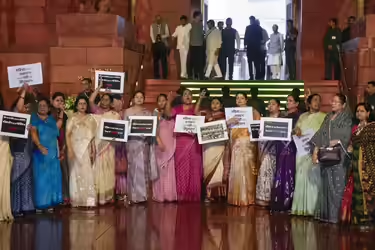
Now, why did the opposition shoot it down so hard? They weren’t against women’s reservation – they kept repeating they supported it wholeheartedly and had backed the 2023 Act. Their beef was the packaging. Rahul Gandhi, Priyanka Gandhi, Mallikarjun Kharge, MK Stalin, K Chandrashekar Rao (KTR), and pretty much the entire INDIA bloc called it a “backdoor delimitation” wrapped in women’s rights. They said the government was using the quota as an alibi to sneak in a politically motivated redraw right now, ahead of key state polls in Tamil Nadu, West Bengal and others. States like Tamil Nadu, Kerala, Karnataka and Andhra have done the hard work on family planning for decades – lower fertility rates, better health indicators, stronger economies. Why should they be “penalised” by having their relative voice diluted when the North’s higher population growth gets rewarded with more MPs? They called it gerrymandering by another name, pointing to how delimitation was used in J&K and Assam. Congress’s Gaurav Gogoi said it straight: “This is not about women; this is about seizing power through delimitation.” The opposition held strategy meetings at Kharge’s house, united across party lines, and voted as a bloc. The Constitution amendment needed a two-thirds majority – 352 votes in the Lok Sabha. It got 298 in favour and 230 against. Fell short by 54 votes. Speaker announced it failed. Government immediately withdrew the other two bills.

Priyanka called it a “black day for the Centre” and a “victory for democracy.” Rahul said it was to “defend the idea of India.” Southern CMs warned of mass mobilisation. Even some who normally back the BJP on other issues saw the federalism red flag.
A pure population-based delimitation after the next census without expansion could see southern states lose 10-20% of their current share while Uttar Pradesh, Bihar, Rajasthan and Madhya Pradesh balloon. The government’s 50% expansion model tried to soften that blow, but the opposition wasn’t buying the timing or the trust. They also grumbled that the real conversation – a caste census, deeper federal devolution of funds and powers – was being sidelined. Plus, doing this in the middle of state election seasons smelled of electoral engineering to them.
So what happens next? Short term: women’s reservation stays on ice. The 2023 Act can’t kick in without the delimitation trigger. No new seats, no new women quota in the next general elections or state polls. The current freeze on seat numbers continues till the first census after 2026 (likely 2027). After that, Articles 81 and 82 of the Constitution automatically require fresh delimitation based on the new population figures – and that one will be the full, no-holds-barred version unless Parliament passes another amendment. The government has already said it respects the House’s verdict and won’t push the defeated bills further right now. But nobody believes the issue is dead. Expect it to roar back after the census data lands, probably with fresh negotiations or another attempt at expansion.
Longer term, this episode has lit a fuse under the North-South divide. Southern parties are already talking coordinated protests, public campaigns, even threats to revisit their contribution to the national tax pool if their political weight shrinks. It strengthens the opposition’s narrative of a “one-nation” centralising push that ignores regional realities. For the BJP, it’s a setback – they couldn’t deliver the women’s quota they had hyped, and the defeat (first big one in a while on a constitutional bill) shows the INDIA bloc can still unite when it counts. But they’ll likely frame the opposition as anti-women and anti-reform.
The bigger truth? Delimitation was always coming. India’s population has grown unevenly since 1971 (when the last major freeze was based on). Keeping seats frozen forever would have been undemocratic. But doing it without addressing the very real anxieties of states that invested in population control, education and governance feels unfair to millions in the South. The Centre tried a pragmatic middle path – expand the house, protect shares, empower women – but the trust deficit in today’s polarised politics was too deep. Opposition saw a trap; government saw a solution. Both sides dug in.
What we’re left with is a pause, not an end. The next census will force everyone back to the table. Till then, the women who were promised one-third representation will have to wait a little longer, and the electoral map of India remains frozen in 2008 numbers while the country changes underneath it. When that data drops, expect fiery debates on federalism, fiscal justice, and whether “one person, one vote” should come at the cost of balanced regional voices.
This wasn’t just a parliamentary vote. It was a loud reminder that in a democracy as diverse as ours, numbers matter – but so does the feeling that every region’s hard work is respected. The delimitation fight is far from over. It’s only paused. And when it resumes, it will test the idea of India like few issues have.
Sources
• Times of India: “Delimitation decoded: What the Centre tried to do, why opposition shot it down & what happens next” (April 19, 2026)
• The Wire: INDIA Bloc to Oppose Delimitation Bill (April 15-16, 2026)
• BBC: Delimitation – Will north India’s gain be south India’s loss?
• The Hindu: United Opposition defeats women’s quota Constitutional Amendment Bill
• The Federal, Al Jazeera, and PRS India legislative summaries for bill details and voting reports.