
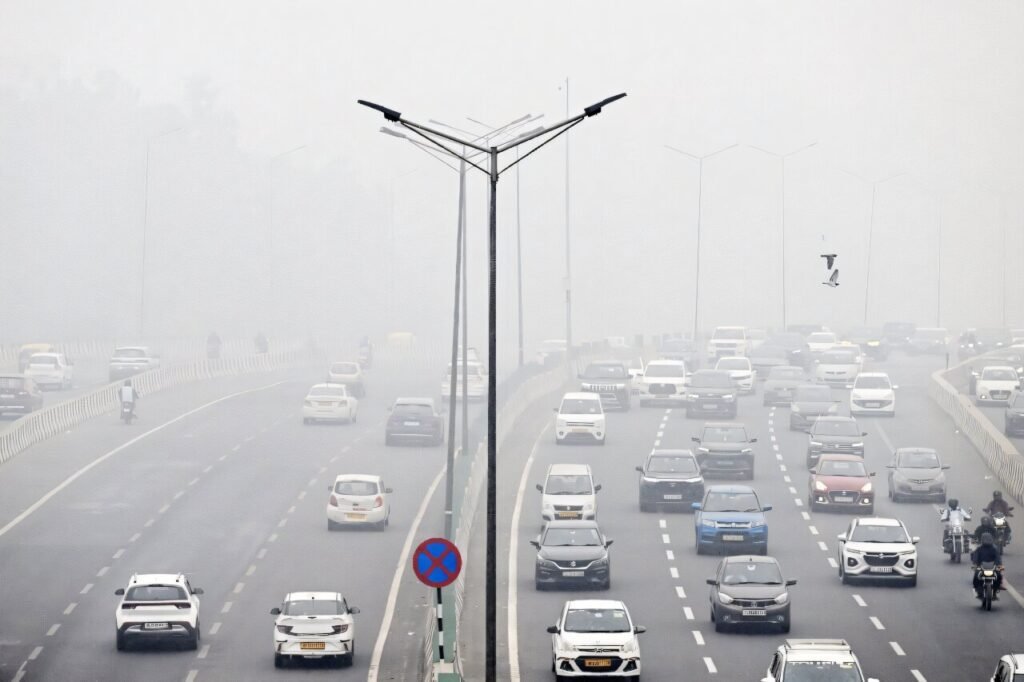
Imagine waking up to a world shrouded in a gray haze so thick it blurs the line between day and dusk. The air tastes metallic, your throat scratches with every inhale, and outside, the iconic minarets of India Gate fade into an eerie fog. This isn’t a dystopian novel—it’s Delhi, right now, gasping for breath as its Air Quality Index (AQI) skyrockets to “severe” levels, hovering between 374 and 448 across the National Capital Region (NCR). Welcome to the annual ritual of smog season, but in 2025, it’s hitting harder than ever. With headlines screaming “Delhi Gasps for Air” and protests erupting at Jantar Mantar, the question on every resident’s mind is: Is this the new normal for India’s bustling heart?
The Siege: AQI at Alarming Heights
As of this morning, Delhi’s overall AQI clocked in at 448 by 7 AM, plunging the city into the “severe” category where even healthy adults are advised to avoid outdoor exertion. Noida fared worse at 558, while hotspots like Anand Vihar reported a choking 437. For context, an AQI above 400 is a kin to smoking 10-15 cigarettes a day—except you’re not choosing it; it’s forced upon you by the poisoned skies over NCR. The Central Pollution Control Board (CPCB) bulletin confirms PM2.5 levels as the primary culprit, with fine particles infiltrating lungs and bloodstreams like invisible exterminator.
This isn’t excess. Post-Diwali stalk burning in neighboring Punjab and Haryana has collided with winter’s stagnant winds, trapping emissions from vehicles, industries, and construction dust in a toxic cocktail. Delhi’s air pollution crisis 2025 has increase faster than last year, with “very poor” days stretching into weeks. And while the government activated GRAP Stage 4 calamity measures—banning erection and imposing odd-even vehicle rules—these feel like Band-Aids on a gaping wound.
Poisoned Skies: When Bans Fall Short
Enter the construction ban, a desperate GRAP IV staple meant to curb dust from Delhi’s endless urban sprawl. Linear projects like roads and pipelines are halted, yet reports paint a grim picture: imposition is spotty, and illegal sites continue emit plumes of silica-laden fog. The Supreme Court, in a recent ruling, rejected a blanket ban, calling for “no temporary solutions” and urging long-term fixes like better waste management. But on the ground, it’s business as usual for some—cranes swing, excavators rumble, and the NCR’s poisoned skies thicken.
Schools have shifted to hybrid mode for Classes 1-5, a heartbreaking concession as young lungs, still developing, absorb the brunt. Elderly residents, with pre-existing conditions like asthma and COPD, are confined indoors, their golden years eclipsed by oxygen masks and nebulizers. Hospitals report a 20-30% spike in respiratory cases, with underage medicine wards overflowing. One mother at AIIMS shared, “My five-year-old coughs through the night. We’re rationing playtime like wartime supplies.” It’s a stark reminder: Delhi’s smog isn’t just environmental—it’s a public health annihilation targeting the vulnerable.

Breathing Poison: Protests and Please for a National Emergency
Disappointment boiled over today at Jantar Mantar, where hundreds rallied under banners reading “Air to Breathe, Not to Die.” Chanting “Modi Ji, Saans Lo!” (Modi Ji, Let Us Breathe!), protesters from across NCR demanded a national emergency declaration, echoing calls from environmentalists and health experts. “This is beyond state borders—it’s a federal failure,” shouted activist Vimlendu Jha of Swachh Saans Abhiyan. The rally, the second in a week, highlighted stalk burning’s role: over 1,200 farm fires in Punjab alone this season, each emit toxins identical to a coal plant’s daily output.
Demonstrator aren’t alone. The Supreme Court has slammed the government for “inaction,” while the WHO warns Delhi’s pollution shortens lives by up to 10 years. Calls for a “National Health Emergency” grow louder, with proposals for subsidized air purifiers, mandatory crop residue alternatives, and even flight diversions from Indira Gandhi International Airport due to visibility dips below 500 meters. Yet, as one protester jest, “Emergency measures come and go with the winds— we need revolution in the air.”
The Human Cost: Stories from the Smog firing line
Behind the stats are souls suffocating in silence. Take Rajesh Kumar, a 62-year-old retiree from Rohini: “I moved here for my grandchildren’s future. Now, I fear they won’t outlive the haze.” Or Priya Sharma, a teacher in Gurgaon, whose classroom windows are sealed against the “toxic soup” outside, turning lessons into muffled whispers. Even Delhi’s vibrant recital season—usually a November highlight—is heave: musicians cancel gigs, citing health risks as “next to criminal.”
Economically, it’s a stranglehold too. Tourism dips, productivity plunge with work-from-home injunction, and healthcare costs soar. A recent study pegs annual losses at ₹1.36 lakh crore—more than enough to fund green tech nationwide. For the affluent, escape is an option: luxury “clean air” vacations to the hills. But for millions in slums like Yamuna Pushta, it’s lockdown in lung-irritating homes, with no AC filters or N95 masks in sight.
Is This the New Normal? Breaking the Smog Cycle
Delhi’s air quality crisis isn’t paperback—it’s perennial, exacerbated by climate change’s erratic monsoons and policy paralysis. But 2025 feels like a tipping point. With AQI forecasts predicting “severe” through Thanksgiving (or should we say, “No-Thanks-Giving” for clean air?), experts urge radical shifts: Electrify transport (only 10% of buses are EV yet), impose farm modernization subsidies, and plant urban forests at scale.
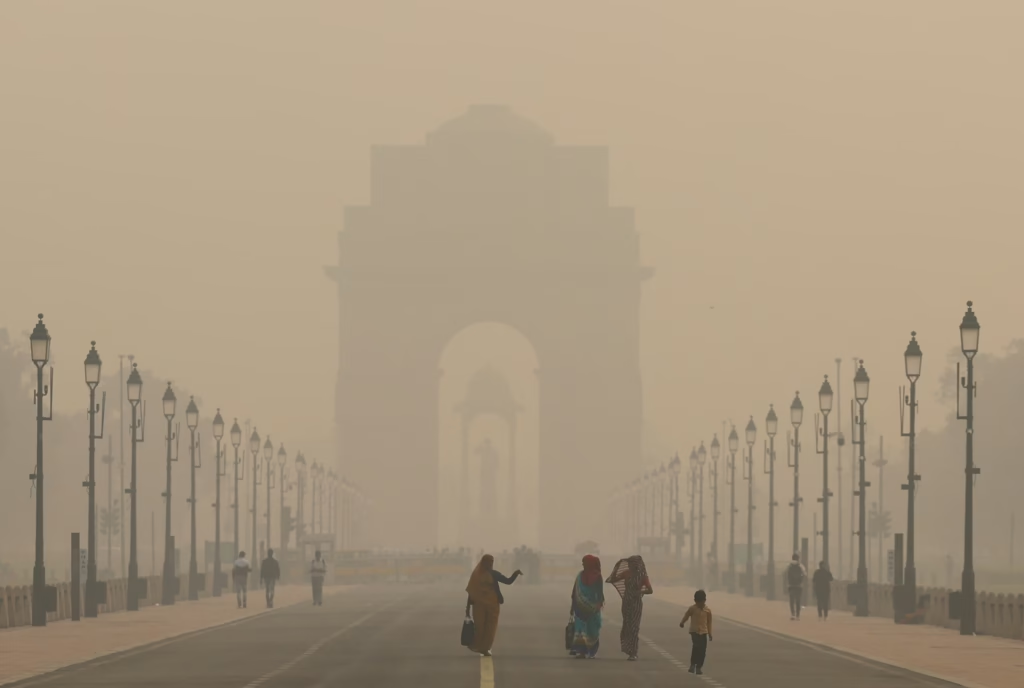
The silver lining? Community action. Apps like AQI Tracker are buzzing with citizen reports, and youth-led cleanups dot the Yamuna banks. As one Jantar Mantar mutineer declared, “We’ve marched for farmers, for women—now for our lungs.”
Delhi, the city of dreams, can’t afford to choke on nightmares. Demand better: Write to your MP, switch to public transport, support anti-bristle tech. Because in this gag crisis, every breath counts. What’s your smog story?