
On 17th of October 2025, Gujarat Chief Minister Bhupendra Bhai Patel announced one of the largest ever cabinet reshuffles, in Gujarat government. The Cabinet, earlier consisting 16 ministers, is now expanded to 26 ministers (including Chief Minister). The reshuffle has caused a complete reset in state-council. All existing 16 ministers submitted their resignation to the chief minister. With Gujarat assembly elections in 2027, the reshuffle and expansion of cabinet can be a step to bring in newer faces and refresh the council. According to the constitution, up to 27 ministers are allowed in Gujarat and the provided space is now being used by government to grow the size of cabinet.

The step also denotes message of a constant focus from leadership and renewed enthusiasm in the cabinet. Gujarat government, will be looking forward to have experience from multiple fields in the cabinet. This offers new hope for people of Gujarat: that their concerns might be heard by the new set of ministers. An important focus has also been given to the representation with three women ministers (earlier only one women minister was there) and representation of tribal, OBC and Scheduled caste leaders.
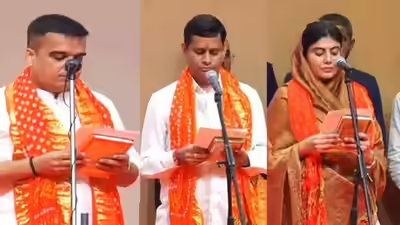
Some of the newly appointed cabinet ministers-
- Raviba Jadeja- She is wife of cricketer Ravindra Jadeja. It will be her first ministerial role and she is given the charge of Primary, Secondary and Adult education.
- Arjun Modhwadia- Earlier with the Congress, he joined BJP in 2024 and now inducted as a new minister.
- Naresh Patel – He is inducted as minister with tribal development, cottage industries and rural development portfolios. He is a tribal leader from Gandevi in Navsari district.
- Jitendra Vaghani – Jitubhai Savjibhai Vaghani has a prior experience of legislation as he was the Minister for Science and Technology in 2021. He is also a part new list of appointed 19 ministers.
- Darshan Vaghela
- Manisha Vakil – She is also one of the women ministers, appointed for the cabinet.
- Ishwari Patel –Coming from south Gujarat, He is the new minister of state for Water supply.
Six ministers were retained, even after their resignation.
- Harsh Sanghavi – He is appointed as Deputy Chief Minister of Gujarat. He is also holding the office of ‘Home Ministry’ of Gujarat.
- Kanubhai Mohanlal Desai – He was also one of the six ministers retained. He will be continuing as the State-Minister of Finance and Urban Development.
- Rushikesh Ganeshbhai Patel – He is given the portfolios of Energy, Petrochemicals, Panchayat and Rural housing.
- KunvarjiBavaliya – He is Ex MP from Rajkot, now holding the post of Labour, Skill Development and Employment minister of Gujarat.
- Parshottam Solanki – MLA from Bhavnagar, holds the office of Fisheries ministry of Gujarat.
- Praful Pansheriya – He is Minister of Health, Family Welfare and Medical Education of Gujarat.
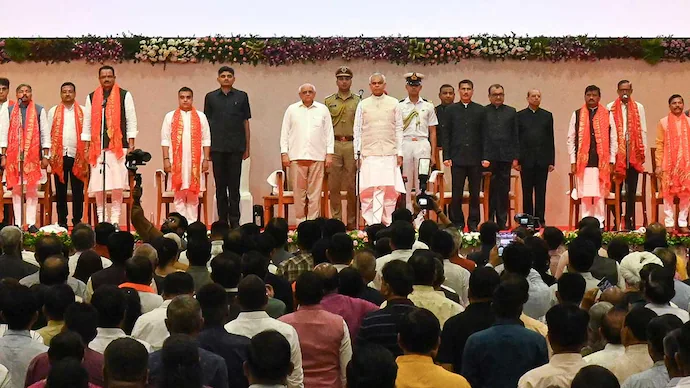
What are the most significant changes?
- Harsh Sanghvi is promoted to Deputy Chief Minister of Gujarat. He is in his mid-40s and relatively young compared to other state ministers. This shows the government’s decision of elevating younger leadership and forward-looking, dynamic leadership.
- Representation from Saurashtra, tribal areas and women has been increased. It’s a great decision for regional and community adjustment as well as for strengthening government’s electoral base.
- Six of the ministers are from Patidar community while eight are OBCs and Shangavi, a micro minority Jain community. This allocation shows the consideration towards the representation of minorities in the state government.
Why this reshuffle matters for the people of Gujarat?
Representation: With fresh faces from other districts, tribal areas, women and younger politicians, the expectation is that more voices are heard and more areas receive attention.Governance focus: The type of portfolios allocated (e.g., Home, Education) indicate where the government will direct its energy — e.g., schools, security, rural development.
Change & continuity: While there is a rejuvenation of sorts, retaining experienced ministers ensures that institutional memory and ongoing projects don’t stall.
Elections ahead: Since elections are coming, the government is sending a message: we’re evolving, listening, preparing. For citizens this can mean new agendas, new promises, and (ideally) renewed accountability.
Expectations are raised: Change brings expectations. New ministers usually enjoy an initial “honeymoon” period. The citizens will observe the way they deliver, the way they are accessible, and how they tackle local issues. So, BJP’s strategy to reward performance, balance regional representation, and get ready for the 2027 assembly elections is reflected in the recent Gujarat cabinet reshuffle. The government hopes to preserve public confidence while reviving governance by appointing new ministers from a variety of communities and emphasizing administrative effectiveness. This shift reflects a forward-thinking strategy that combines youth and experience to improve political outreach and policy implementation. In the end, Gujarat’s developmental vision is reaffirmed and leadership is renewed as a result of the reshuffle.