
Heavy Rainfall in West Bengal on 5th of October triggered a devastating landslide in Darjeeling, one of the worst in last decade. At least 23 deaths have been reported, including children, elderly people and workers. Officials said that homes have been swept away, roads severed and hundreds of tourists have been left stranded. Casualties were reported bromidic, Darjeeling, Cursing and parts of Jalpaiguri district according to the reports by West Bengal’s administration and NDRF (National Disaster Response Force).

Chief Minister Mamata Banerjee held a meeting as the situation got worse and visited affected areas on 6thof October. Mamata Banerjee tweeted on X “I am deeply worried and concerned that several areas in both North Bengal and South Bengal have ben flooded due to sudden huge rains within a few hours last night as well as due to rush of excessive river waters in our State from outside.” She also advised tourists in North Bengal to stay put at their respective places till the time state police evacuates them. She added on X “State HQ and the districts are having 24×7 control rooms. Please connect my NabannaDisaster Management Control Room at +91 33 2214 3526 and +91 33 2253 5185, while the Toll-free Numbers are + 91 86979 81070 and 1070.”.
NDRF teams alongside police were deployed in affected areas and rescue operations were conducted. A red alert warning was already issued by IMD (Indian Meteorological Department) regarding heavy rainfall. The repeated disasters in Northern and North-Eastern India due to heavy rainfall are testing the Disaster management and early warning systems in the country. Apart from 23 killed, many still missing and dozens injured were reported.
What caused the sudden and heavy rainfall?
- Low-pressure and cyclonic system buildup over the Bay of Bengal was one of the major reasons. Additionally, moisture from Bay of Bengal causes frequent cyclone formations and rainfall in the region.
- Moisture carrying wind when collided with the Darjeeling and Mikir hills, caused orographic rainfall which in turn caused landslide in those hilly areas.
- Monsoon in its later phase, while returning causes precipitation in north-eastern and eastern India.
In addition to the above causes, continuous rainfall this year has loosen up the soil which triggers easy gravitation induced landslides.
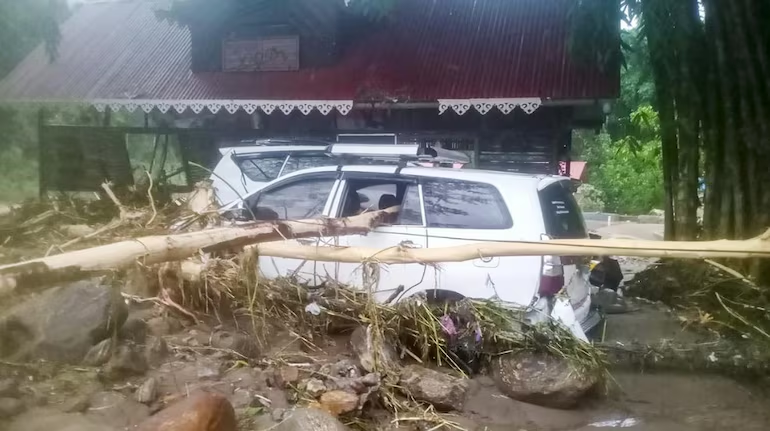
What is the cost of damage done by Landslide?
- Dudhia iron bridge which collapsed on 0ctober 5, connected Mirek and Kurson. Broken bridge not only isolates people but also effects student’s connectivity to school, immediate medical help and market supply chain.
- Darjeeling being a popular tourist hotspot, is highly dependent on the means of tourism. Recent landslide has resulted in blocked routes and halt on the transportation.
- Alongside the loss of human-lives, infrastructure damages drain out Government budget because of repairment fee and compensation amount given to families of deceased.
- Natural disaster-prone areas set fear in the minds of tourists coming from across the world. For example- this landslide can lead to reduced tourism the rainy season, eventually resulting in seasonal unemployment.
How the ruling government and opposition have reacted?
Rapid relief and rescue measures were underway after the landslides occurred with the mobilization of NDRF and local administration. Relief camps were also set up to provide shelter and essential supplies (Food, Medicine, Water) to displaced people. The CM announced aid of RS 5 lakh each to the families of deceased. She also announced a Special Home guard’s job to a kin in each family stating that the state government stands with the families of victims.
However, BJP has criticized Mamata Banerjee for her participation in a Durga Puja carnival and not postponing it while the state was dealing with such disaster. Other opposition leaders also accused state government of neglecting “North Bengal” compared to development and resource allocations in other regions.
What can be approaches to recover and heal?
- State should implement Early Warning Systems to alert people in advance for safe shelter and evacuation plans.
- Better environmental care, tree plantation and controlled construction can ensure stable soil holdings avoiding the risk of such disasters in future.
- Improved infrastructure and land management by assessing risky slopes and avoiding construction at such places will make the risk of damage less severe.
- Support from the government in such difficult times in form of compensation and alternative work can surely help them rebuild their homes as well as their hopes.

Such repeated tragedies and natural disasters are warnings to the mankind, reminding it of nature’s power. Government’s attention towards wise construction and sustainability of nature is highly needed. Darjeeling along with sympathy also needs a planning keeping in mind the fragile hills. These disasters are also a test of governance and now government’s efforts will decide not just only the recovery of Darjeeling but also the intensity of damage in future tragedies.